

Unlike genomic DNA, cfDNA has specific fragmentation patterns. The ambiguous definition of “fragment length” by various alignment software is raising concerns: see page 9 footnote in SAM file format spec: https://samtools.github.io/hts-specs/SAMv1.pdf\
cell-free DNA data fragmentomic analysis requires single-molecule level resolution, emphasising the importance of accurate/unbiased feature extraction. The traditional tools built for solid tissue sequencing do not consider the specific properties of cfDNA sequencing data (e.g., cfDNAs are naturally fragmented with a modal fragment size of 167bp, and di-/tri-nucleotide peaks in the length distributions). Researchers might inadvertently extract the features using a sub-optimised method.
cfDNAPro is designed to resolve this issue and standardize the cfDNA fragmentomic analysis, complying with the existing building blocks in the bioconductor R ecosystem. We wish cfDNAPro to provide a catalyst for further improvements in the implementation and development of cfDNA biomarkers and multi-modal AI for various health conditions.
Input
A paired-end sequencing bam file, with duplicates marked. (e.g., using the MarkDuplicates function from Picard). Please do not impose any filtering on the bam files; For example, do not filter by the proper-pairs flag. cfDNAPro filters the reads by following default criteria (You can toggle those criteria using parameters built-in readBam() function): (1) Reads mapping qualities less than 30 were discarded; (2) Reads must be paired. Of note, by default, cfDNAPro doesn’t impose filtration by “proper pair”; (3) No duplicate; (4) No secondary alignment; (5) No supplementary alignment; (6) No unmapped reads.
Note: remember to choose the correct genome_label, a parameter in readBam() function, based on the ref genome you used for alignment. At the moment, it supports three different ref genomes, hg19, hg38 and hg38-NCBI, For details see readBam() R documentation by typing ?readBam in the R console or see source code:https://github.com/hw538/cfDNAPro/blob/master/R/readBam.R
Output
cfDNAPro can extract (i.e., “quantify in a standandised and robust way”) these features/bio-markers: - fragment length - fragment start/end/upstream/downstream motifs - copy number variation - single nucleotide mutation - more…
Feature extraction depends on essential data objects/R packages in the Bioconductor ecosystem, such as Rsamtools, plyranges, GenomicAlignments, GenomeInfoDb and Biostrings. Data engineering depends on packges in the tidyverse ecosystem, such as dplyr, and stringr. All plots depend on ggplot2 R packge.
For issues/inquiries, please contact: Generic enquiry: Nitzan Rosenfeld Lab admin mailbox: bci-nrlab-admin@qmul.ac.uk Fragment length, motif and CNV related questions: Haichao Wang: wanghaichao2014@gmail.com SNV/SNP related questions: Paulius D. Mennea: paulius.mennea@cruk.cam.ac.uk
Installation
Option 1 (recommended): Use Docker or Singularity:
#Step 1: Pull the Docker Image
docker pull zetianjia/cfdnapro:1.7.3
#Step 2: Launch R inside the Container
docker run -it zetianjia/cfdnapro:1.7.3 R --no-save
Singularity
#Step 1: Pull the Docker Image
singularity pull docker://zetianjia/cfdnapro:1.7.3
#Step 2: Launch R inside the Container
singularity exec -e cfdnapro_1.7.3.sif R --no-save
Option 2: Use anaconda to build an env using the following codes:
conda create -y cfdnapro_r4.3.3 r-base=4.3.3
conda activate cfdnapro_r4.3.3
conda install -y -c conda-forge r-xml2 r-curl
conda install -y -c conda-forge libgdal
conda install -y r::r-libgeos
conda install -y -c conda-forge udunits2
# Install devtools if it's not already installed
Rscript -e 'if (!requireNamespace("devtools", quietly = TRUE)) install.packages("devtools", repos = "https://cloud.r-project.org")'
# IMPORTANT: Install Matrix version 1.6-5 (compatible with R 4.3)
Rscript -e 'devtools::install_version("Matrix", version = "1.6-5", repos = "https://cloud.r-project.org")'
# IMPORTANT: Install MASS version 7.3-58.35 (compatible with R 4.3)
Rscript -e 'devtools::install_version("MASS", version = "7.3-58.3", repos = "https://cloud.r-project.org")'
# IMPORTANT: Install units package version 0.8-2 (compatible with R 4.3)
#Rscript -e 'devtools::install_version("units", version = "0.8-2", repos = "https://cloud.r-project.org")'
# IMPORTANT: Install rtracklayer package version 0.8-2 (compatible with R 4.3)
Rscript -e 'devtools::install_version("rtracklayer", version = "1.62.0", repos = "https://cloud.r-project.org")'
Rscript -e 'if (!requireNamespace("pacman", quietly = TRUE)) install.packages("pacman", repos = "https://cloud.r-project.org"); pacman::p_load(xml2, curl, httpuv, shiny, gh, gert, usethis, pkgdown, rcmdcheck, roxygen2, rversions, urlchecker, BiocManager)'
# IMPORTANT: you have to set the timeout time as these packages are quite big, if timeout is too short, the installation might fail due to a slow downloading process
Rscript -e 'options(timeout=3600); if (!requireNamespace("BiocManager", quietly = TRUE)) install.packages("BiocManager"); BiocManager::install("OrganismDbi")'
Rscript -e 'options(timeout=3600); pkgs <- c("GenomicAlignments", "rtracklayer", "GenomicFeatures", "BSgenome", "BSgenome.Hsapiens.UCSC.hg38", "BSgenome.Hsapiens.UCSC.hg19", "BSgenome.Hsapiens.NCBI.GRCh38", "Homo.sapiens", "plyranges", "TxDb.Hsapiens.UCSC.hg19.knownGene"); new <- pkgs[!pkgs %in% installed.packages()[,"Package"]]; if(length(new)) BiocManager::install(new)'
Rscript -e 'pacman::p_load(car, mgcv, pbkrtest, quantreg, lme4, ggplot2, ggrepel, ggsci, cowplot, ggsignif, rstatix, ggpubr, patchwork,ggpattern)'
Rscript -e 'devtools::install_github("asntech/QDNAseq.hg38@main")'
# install cfDNAPro
Rscript -e 'devtools::install_github("hw538/cfDNAPro", build_vignettes = FALSE, force = TRUE)'
Quick Start 1
Read bam file, return the fragment name (i.e. read name in bam file) and alignment coordinates in GRanges object in R. If needed, you can convert the GRanges into a dataframe and the fragment length is stored in the “width” column.
library(cfDNAPro)
# read bam file, do alignment curation
frags <- readBam(bamfile = "/path/to/bamfile.bam")
# convert GRanges object to a dataframe in R
frag_df <- as.data.frame(frags)
# You can calculate fragment length and motifs from the frags object (i.e., the output of readBam() function)
frag_length <- callLength(frags)
frag_motif <- callMotif(frags)
A screenshot of the output:
Quick Start 2
Read in bam file, return the fragment length counts. A straightforward and frequent user case: calculate the fragment size of a bam file, use the following code:
# install cfDNAPro newest version
if (!require(devtools)) install.packages("devtools")
devtools::install_github("hw538/cfDNAPro", build_vignettes = FALSE)
# calculate insert size of a bam file
library(cfDNAPro)
frag_lengths <- read_bam_insert_metrics(bamfile = "/path/to/bamfile.bam")
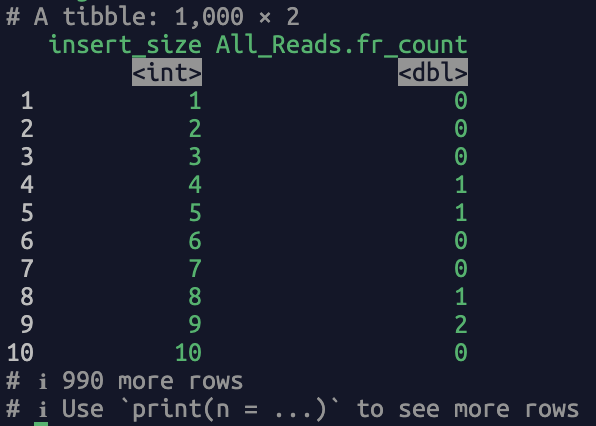
The returned dataframe contains two columns, i.e., “insert_size” (fragment length) and “All_Reads.fr_count” (the count of the fragment length). A screenshot of the output:
News
cfDNAPro paper is published on Genome Biology (May 2025)!
In addition to “bam” and “picard” files as the input, now we accept “cfdnapro” as input_type to various functions, this ‘cfdnapro’ input is exactly the output of read_bam_insert_metrics function in cfDNAPro package. It is a tsv file containing two columns, i.e., “insert_size” (fragment length) and “All_Reads.fr_count” (the count of the fragment length). ### cfDNAPro 1.5.3 (Oct 2022)
added support for hg38-NCBI version, i.e. GRCh38 ### cfDNAPro 0.99.3 (July 2021)
Added ‘cfDNAPro’ into the “watched tag”. ### cfDNAPro 0.99.0 (May 2021)
Now cfDNAPro supports bam file as input for data characterisation.
Coding style improvements.
Documentation improvements.
Submitted to Bioconductor.
Citation
Please cite this paper:
Wang, H., Mennea, P.D., Chan, Y.K.E., Cheng, Z. et al. A standardized framework for robust fragmentomic feature extraction from cell-free DNA sequencing data. Genome Biol 26, 141 (2025). https://doi.org/10.1186/s13059-025-03607-5
cfDNAPro
Official tutorials
This landing page aims to provide a quick start. For in-depth documentation, please visit: https://cfdnapro.readthedocs.io/en/latest/
Declaration
cfDNAPro is designed for research only.
Why cfDNAPro?
Unlike genomic DNA, cfDNA has specific fragmentation patterns. The ambiguous definition of “fragment length” by various alignment software is raising concerns: see page 9 footnote in SAM file format spec: https://samtools.github.io/hts-specs/SAMv1.pdf\ cell-free DNA data fragmentomic analysis requires single-molecule level resolution, emphasising the importance of accurate/unbiased feature extraction. The traditional tools built for solid tissue sequencing do not consider the specific properties of cfDNA sequencing data (e.g., cfDNAs are naturally fragmented with a modal fragment size of 167bp, and di-/tri-nucleotide peaks in the length distributions). Researchers might inadvertently extract the features using a sub-optimised method.
cfDNAProis designed to resolve this issue and standardize the cfDNA fragmentomic analysis, complying with the existing building blocks in the bioconductor R ecosystem. We wish cfDNAPro to provide a catalyst for further improvements in the implementation and development of cfDNA biomarkers and multi-modal AI for various health conditions.Input
A paired-end sequencing bam file, with duplicates marked. (e.g., using the MarkDuplicates function from Picard).
Please do not impose any filtering on the bam files; For example, do not filter by the proper-pairs flag.
cfDNAProfilters the reads by following default criteria (You can toggle those criteria using parameters built-inreadBam()function):(1) Reads mapping qualities less than 30 were discarded;
(2) Reads must be paired. Of note, by default, cfDNAPro doesn’t impose filtration by “proper pair”;
(3) No duplicate;
(4) No secondary alignment;
(5) No supplementary alignment;
(6) No unmapped reads.
Note: remember to choose the correct
genome_label, a parameter inreadBam()function, based on the ref genome you used for alignment. At the moment, it supports three different ref genomes, hg19, hg38 and hg38-NCBI, For details see readBam() R documentation by typing?readBamin the R console or see source code:https://github.com/hw538/cfDNAPro/blob/master/R/readBam.ROutput
cfDNAProcan extract (i.e., “quantify in a standandised and robust way”) these features/bio-markers: - fragment length - fragment start/end/upstream/downstream motifs - copy number variation - single nucleotide mutation - more…Feature extraction depends on essential data objects/R packages in the Bioconductor ecosystem, such as
Rsamtools,plyranges,GenomicAlignments,GenomeInfoDbandBiostrings.Data engineering depends on packges in the tidyverse ecosystem, such as
dplyr, andstringr.All plots depend on
ggplot2R packge.For issues/inquiries, please contact:
Generic enquiry: Nitzan Rosenfeld Lab admin mailbox: bci-nrlab-admin@qmul.ac.uk
Fragment length, motif and CNV related questions: Haichao Wang: wanghaichao2014@gmail.com
SNV/SNP related questions: Paulius D. Mennea: paulius.mennea@cruk.cam.ac.uk
Installation
Option 1 (recommended): Use Docker or Singularity:
Thanks zetian-jia for building the docker image,
please refer to github.com/zetian-jia/cfDNAPro_docker
Docker
Singularity
Option 2: Use anaconda to build an env using the following codes:
Quick Start 1
Read bam file, return the fragment name (i.e. read name in bam file) and alignment coordinates in GRanges object in R. If needed, you can convert the GRanges into a dataframe and the fragment length is stored in the “width” column.
A screenshot of the output:
Quick Start 2
Read in bam file, return the fragment length counts. A straightforward and frequent user case: calculate the fragment size of a bam file, use the following code:
The returned dataframe contains two columns, i.e., “insert_size” (fragment length) and “All_Reads.fr_count” (the count of the fragment length). A screenshot of the output:

News
cfDNAPro paper is published on Genome Biology (May 2025)!
read_bam_insert_metricsfunction in cfDNAPro package. It is a tsv file containing two columns, i.e., “insert_size” (fragment length) and “All_Reads.fr_count” (the count of the fragment length). ### cfDNAPro 1.5.3 (Oct 2022)Citation
Please cite this paper:
Wang, H., Mennea, P.D., Chan, Y.K.E., Cheng, Z. et al. A standardized framework for robust fragmentomic feature extraction from cell-free DNA sequencing data. Genome Biol 26, 141 (2025). https://doi.org/10.1186/s13059-025-03607-5